All Our Corners of the Internet
From Piczo to Present
Kyle Sarte 993 words 5 min Pinned
This blog, Our Common Time, exists partially in tribute to that era of my early Internet, when it seemed more common to discover sites that felt personal—simple sites that existed just to exist, without any commercial, corporate, or monetary incentive.
It’s the summer of 2006 when Catsy introduces me to Piczo, footnote 1.
- "You should make a Piczo."
- "What's that?"
Just as I’m typing what is piczo into Google, I get another MSN notification—she’s sent a link:
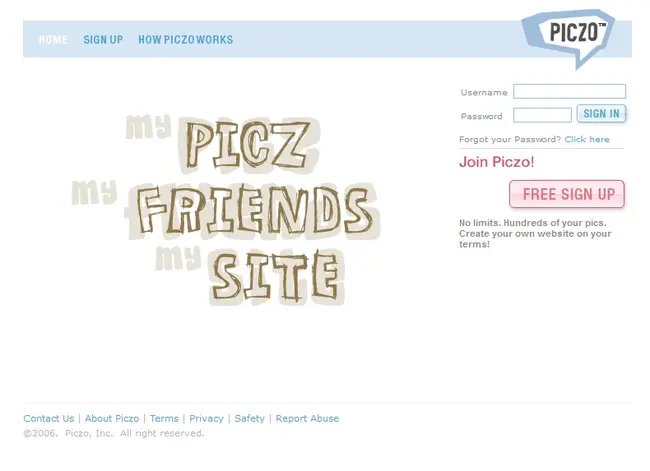 Piczo homepage circa 2006
 Another message, this time the link to her Piczo page. Cool. I ask her if she made it herself. Yes, with some help from her older sister.
And so I rush to sign-up, excited to make my own page on this cool new thing called Piczo.
The Piczo page editor lets me add text, pictures, and videos to my custom website, even change my page’s background colour or change how the cursor looks. Dragging-and-dropping to lay everything out feels really intuitive. Text box, margin, hey, I recognize some of these words because…
A couple months earlier, my classmate Jackie and I got called down to the school’s computer lab to meet with Mr. C, the gym teacher who also ran the lab. In the corner of the room where we’d usually find an empty desk, Mr. C was fiddling with a monitor. It looked different from all the other monitors in the lab. It was bigger, shinier, and grey and white all over. The keyboard and mouse were all white too. Our school had just gotten its first iMac—an iMac G5, footnote 2—and Jackie and I were chosen to be the first students to learn how to use it.
The assignment was to learn how to make digital presentations using some new-to-us program called PowerPoint. “This is a really useful program that will help you in the future,” Mr C. told us. We’d learn about text boxes, fonts, working with images, and animating transitions between slides. The presentation would be on electric vehicles—cars that could apparently run on electricity instead of gas. Cool.
Some of the drag-and-drop skills I picked up on that project transferred over to Piczo, but there was one tool that wasn’t familiar, something called an HTML Box. It kind of did the same thing as a Text Box but needed some weird characters like < and > and something about CSS to work properly so I never used it…
Create an Account: It’s Free!
In 2010, Tumblr and Blogger (BlogSpot) would eventually teach me what that HTML Box was good for. But before then, in the years after Piczo, my friends and I would spend hours on MSN sharing every new site we discovered, creating accounts wherever we could and carving out our own little corners all over the Internet.
We had eBaumsWorld, Newgrounds, and every other Flash game site. Video game cheat forums (gamewinners.com, footnote 3 being a personal favourite). All of those smaller one-off pages that felt more like art projects than actual websites. Our shortlived Myspace and Friendster accounts. There was the super niche asiantown.net which all the Filipino, Chinese, and Lao kids at my school had profiles for. Eventually, of course, we settled on Facebook, Twitter, and Instagram, all the while uploading whatever nonsense we could come up with to our very own YouTube channels.
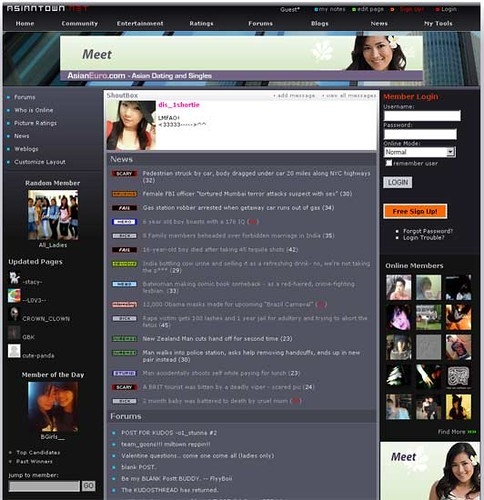 asiantown.net homepage
 A Quieter Web
This blog, Our Common Time, exists partially in tribute to that era of my early Internet, when it seemed more common to discover sites that felt personal—simple sites that existed just to exist, without any commercial, corporate, or monetary incentive. Even larger, community-based sites felt personal in their own way. While I may have been too young to be part of that mid-to-late 90s “Wild West” era of the Internet, I still feel that its influence persisted well into the mid-to-late 2000s when I started actively using it—for me, it felt that way until at least 2010, before Facebook really took over and YouTube would start sowing the seeds of what would become some of today’s online content monetization models.
Smaller pockets on the Internet do still exist (see: NeoCities, footnote 4 and Ye Olde Blogroll, footnote 5) and in recent years I’ve found myself believing more and more in this philosophy of a “quieter” web. Quiet, not necessarily in design (have you seen some of those Neocities sites?) but in purpose; websites unconcerned with search engine optimization, no ads trying to sell you something, no tracking your data for their monetary gain. Sites that are just fine waiting to be stumbled upon, footnote 6.
From Piczo to Present
We’ve come a long way from those first experiments with site builders like Piczo almost 20 years ago. I’ve been a backend developer in the industry for just over 5 years now, but keep my frontend skills in check with personal projects like this blog, kylejsarte.com, footnote 7, and other private web apps because that feeling of a custom website going live has never gotten old to me.
If anything, the feeling is even stronger today because I have the privilege of calling “custom” really custom. This blog is built entirely from scratch—meaning there isn’t a single line of code behind this site that belongs to a company like Tumblr, Blogger, WordPress, or Squarespace. As someone who spent over a decade on those platforms, at one point even as a paying customer, there’s a level of fulfillment I get knowing that every single feature on this site—from the way Tags on the homepage update automatically with each new post or something as simple as the spacing between the paragraphs on this page—is coded from scratch. No having to deal with bloated plugins or overriding someone’s template and prewritten PHP. All this creative freedom on top of a grand total of $0.00 to host and keep this site live.
For the devs: this site is built using SvelteKit and Svelte 5. Posts are written and stored locally in Markdown (so no database) and preprocessed using MDsveX.
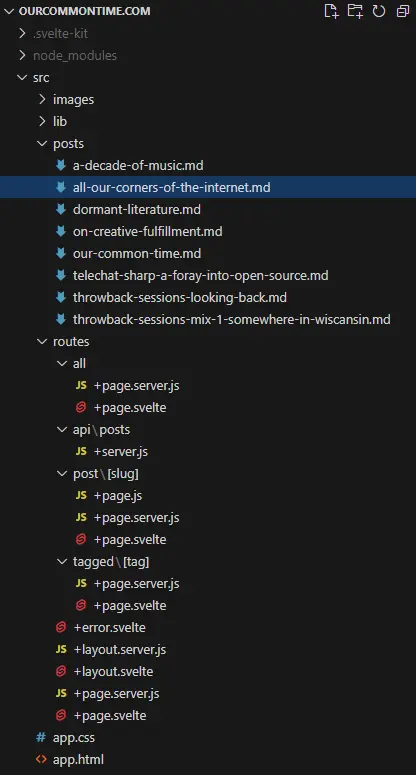 SvelteKit directory tree of ourcommontime.com
Footnotes
-
Piczo was basically MySpace but felt like it was marketed more towards younger teens. Read more on Wikipedia.
-
From Wikipedia: "The iMac G5 is a series of all-in-one personal computers that was designed, manufactured and sold by Apple Computer from 2004 to 2006. The iMac G5 returned to a more traditional design after the "sunflower" iMac G4, with the computer components fitted behind a liquid-crystal display and mounted on an aluminum foot."
-
There were more cheat code sites than I can even remember the names of (GameFAQs was one), but for whatever reason I had this weird loyalty to GameWinners. I remember thinking even back then that GameWinners wasn't the most complete collection of cheat codes, but I always used it. This picture is the UI I remember most.
-
Go to Neocities.
-
Go to Ye Olde Blogroll.
-
From Wikipedia: "StumbleUpon was a website, browser extension, toolbar, and mobile app with a "Stumble!" button that, when pushed, opened a semi-random website or video that matched the user's interests, similar to a random web search engine."
I remember using StumbleUpon most whenever I got bored of scrolling on Tumblr. -
Go to kylejsarte.com.
