A Decade of Music
The Songs That Shaped My Sound
Kyle Sarte 2689 words 12 min
Casio Beginnings — The Casio LK-270, a fancy name for what was nothing more than a budget, entry-level keyboard. Its 61 plastic keys were 27 short of a piano’s full range of 88 and felt nothing like the real thing; they did, however, light up a bright red when you pressed them (cool) and the keyboard came with over 500 built-in tones, MIDI support, and onboard recording functionality. It wasn’t a Steinway but it had everything I thought I’d ever need. It was the summer of 2010 and I had just turned 14 when mom came home carrying the catalyst to my next ten years in music.
This post was originally published on kylejsarte.com on December 7, 2020 and contains only minor modifications from the original text.
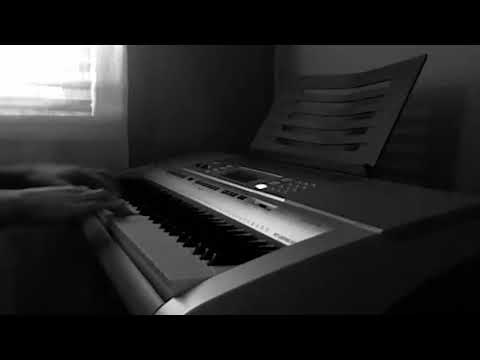
I’ve since upgraded to the Roland FP-10 (a fitting name considering I bought it 10 years after the Casio) but still hold onto the LK-270 sentimentally. The decision to upgrade celebrated a decade of piano and, in a greater sense, a decade of music—10 years of songwriting, producing, and collaborating with other artists, musicians, producers, and DJs.
Finding My Sound — Similar to how a painting could use just one more brush stroke or a book just one more revision, the past 10 years feels like my first draft for the next 10. My music has had a lot of time to find its sound since the early days of that cheap Casio but it would be naive to go without saying that “my” sound isn’t entirely mine.
Whether musician or casual listener, we can all relate to that rare moment of discovering something that completely changes the way we listen to music—our music tastes wouldn’t be what they are today if it wasn’t for that one artist or that one song. As a musician, many of those moments came to me in the form of the following 10 tracks; a decade’s worth of music that not only influenced my taste in music but ultimately shaped my sound.
A Decade of Music — Sometime just before the summer in 2019, the Spotify auto-play algorithm introduced me to a song that would change my listening habits for the next year and a half: without trying I had discovered Hablot Brown.
2019 — Hablot Brown, She Said
She Said had all the familiar production qualities that drew me to songs like D’Angelo’s Chicken Grease or Erykah Badu’s Cleva: it had an addicting bounce to it—an off-kilter guitar intro, a playful bass line in 8ths, and a keys solo that made me wish I studied piano more. It didn’t take long for me to dig into the rest of the band’s music and realize that they were making the music I wanted to make. It was soulful, polished, with layers in the production that made the musician in me jealous.
About a year after discovering them, I got to hop on a video call and talk to the band over Instagram Live to discuss the release of their latest EP OPAQUE, a long-awaited follow-up to a discography that I had on repeat all year. They would return the favour a couple months later by promoting a track I produced with some good friends, No Introductions by August 33, on their Instagram. Honourable mentions for my discoveries of 2019 go to Hablot Brown’s Easy For You, Lonely, Pressure, and Ain’t No Secret.
2018 — FKJ & Masego, Tadow
When a video approaches a quarter-billion views on YouTube, it makes my discovery of it at “only” 20 million seem like I was stumbling upon some hidden gem (far from the truth). The Tadow video had already been out for over a year when I found it but when I did it was all I listened to for a long time.
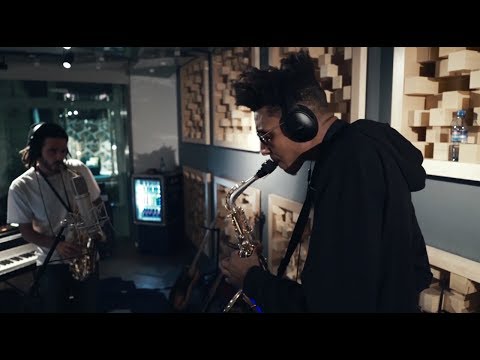
I’d experimented with live-looping, footnote 1 before discovering FKJ but Tadow was different. Something about watching FKJ hop from guitar to bass to keys to sax put the pieces together in my mind: I knew how to play the keys, had the gear, and knew how to live-loop—getting my hands on a guitar, then, meant being one step closer to producing tracks like Tadow. So I bought an electric:
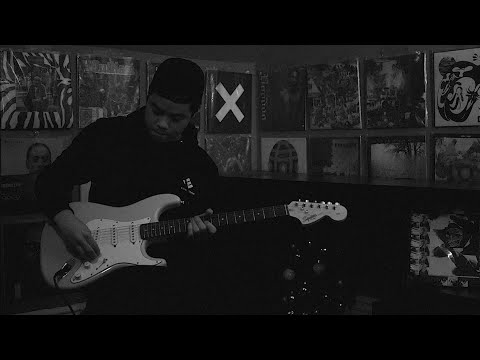
But Tadow wasn’t just about the guitar. Like so many great bass lines, Tadow’s was simple but so effective. By 2018, writing good bass was something I knew my production was lacking. So I picked up a bass. This led to a months-long dedicated study of bass altogether, specifically bass in hip-hop, neo-soul, and R&B—everything from Pino Palladino’s work on D’Angelo’s Voodoo to more recent stuff like Thundercat.
Tadow eventually joined the list of songs I’d overplayed too much to ever listen to again but it was a real turning point that got me thinking about my music through the eyes of instruments other than piano. There’s a line in my mind that splits my production timeline as “Before Tadow” and “After Tadow”. The song really broke me out of my box. I got more creative with my layering, started experimenting with different synth and piano melodies, and was writing catchier, more prominent bass lines.
2017 — saiko, Breezin’
saiko’s Breezin’ defined an era of lo-fi SoundCloud hip-hop for me before “lo-fi hip-hop” took on the meaning it has today. If you’re unfamiliar with lo-fi there’s no shortage of information to catch you up on its rise to prominence over the last 2 to 3 years, but anyone acquainted with the names J Dilla or Nujabes, footnote 2 will know that the subgenre runs its roots even further back than that.
It was late-2017 and autumn in the Exchange District; every other night was spent in one coffee shop or another with Breezin’ playing on repeat and my laptop most likely open to Stack Overflow. I was only a couple months into the start of my journey into software development and lo-fi was just on the edge of what would be the start of a steady rise in the public eye (see: the Google Trends data below). 24/7 YouTube radio channels like ChilledCow, then only broadcasting to audiences in the low thousands, would eventually grow to see over half a billion views worldwide.
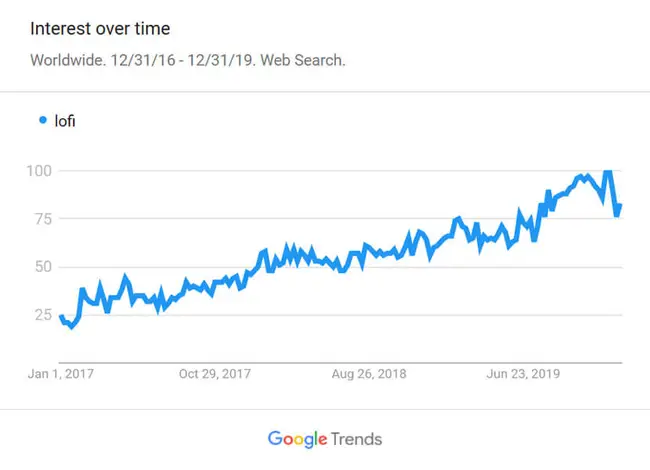 Google Trends data for the word lofi (2017 - 2020)
 By then I’d already been a longtime fan of Madlib, J Dilla, and Nujabes, producers widely known for the sound, so saiko wasn’t without company. Lo-fi as a genre is something my production has mostly moved on from but Breezin’s influence is undeniable in a lot of my work from 2017-2018, e.g.:
2016 — Eliphino, More Than Me
On a random Saturday morning circa November 2015, I found myself the new owner of a DJ controller (specifically the Pioneer DDJ-SB2). The purchase was mostly impulsive, seeing as I had never DJed before, but I enjoyed making custom mixtapes in my DAW, footnote 3 and learning to mix live felt like a fun challenge—so began my brief stint as a DJ. Over the next 2 years I would go from uploading SoundCloud mixes in my bedroom (namely my Throwback Sessions series) to eventually mixing live at events all over the city.
Around this time I got big into Boiler Room DJ videos such as Kaytranada’s famous Montreal set from 2013 and Bonobo’s 2012 London set. After Bonobo’s first track in his set, he mixes into Eliphino’s More Than Me which is then famously rewound, footnote 4 after the drop:
The most famous rewind on Boiler Room? pic.twitter.com/o22U7SOTI0
— BOILER ROOM (@boilerroomtv) January 16, 2018
The song, along with the reaction and atmosphere of the crowd, had me hooked. After that video I dug up everything I could on deep house and UK garage. My mixes, which up to then focused mainly on hip-hop, shifted to include more electronic music. My newfound obsession with house eventually seeped its influence into my own music as I drew inspiration from artists such as Sonny Fodera and Gesaffelstein. The Weeknd (whose importance to my music won’t go unmentioned in this blog post later on) was also making the switch to more house and dance-based production in 2016 with songs like Secrets, Rockin’, A Lonely Night, and I Feel It Coming.
2015 — Tame Impala, Yes I’m Changing
Poppy synths, tight drums, heavy, heavy basslines, and catchy guitar licks—that was the sound of my summer in 2015 when Tame Impala dropped Currents.
Currents was my introduction to Kevin Parker’s Tame Impala. The record, heavily inspired by the laid-back rock of the 80s, made me nostalgic for an era of music I never lived through and spurred further exploration of music in the same genre. Musically, Currents was good but it also sounded good. The drums hit hard, the bass cut through the mix just right, and every synth had its place in the soundstage, footnote 5. The mix and master was made all the more impressive upon finding out that Parker recorded, produced, and mixed the record himself.
2014 — Freddie Gibbs & Madlib, Thuggin’
No album in the past 10 years has thrown me into as deep of a musical rabbit hole as Piñata by Freddie Gibbs & Madlib. Between it and 2004’s Madvillainy, Madlib’s more “infamous” collaboration with MF DOOM, Madlib secured a spot as one of my all-time favourite producers and his sample-based approach, footnote 6 to production would become the framework for a lot of my own music over the next 2 to 3 years.
Studying Piñata set me on a path to discover artists and genres I would have never found on my own. Obscure jazz, funk, and soul records from the 60s, 70s, and 80s found their way into my everyday listening with tracks such as The Ledgends’ (sic) A Fool For You (sampled in Deeper) and Rubba’s Way Star (sampled in Thuggin’). I spent a lot of time (and money) at record stores all over the city after Piñata, sifting through old records in search of samples just as good as the ones used on the album. At one point it stopped being about finding music for me to sample and more about the thrill of dusting off the most obscure records I could find—everything from forgotten French movie soundtracks to Japanese soul.
I bought my first sampler because of Piñata. I bought my first record player, an old Technics, because of it too. My earliest unofficial beat tapes were clear Madlib copycats and even Fever Dreams, my first instrumental EP release, contains samples I first heard through Madlib. 5 years later in 2019, the duo released Piñata’s long-awaited sequel Bandana to as much critical acclaim as the first but nothing since Piñata has come close to the impact it had on my music.
2013 — James Blake, I Am Sold
It wasn’t until James Blake released his sophomore record Overgrown in 2013 that I really started paying attention to his music. I was familiar with a couple songs on his previous self-titled release (Limit To Your Love, The Wilhelm Scream) but his progression as an artist on Overgrown captured a unique blend of piano-based songwriting, electronic music, and hip-hop that was unmatched to my ears at the time.
2012 — XXYYXX, About You
XXYYXX was 16 years old when he released his self-titled album in 2012. I was only a year younger than him when I discovered About You which was basically the musical antithesis to the dubstep I listened to when I was 12 and 13. XXYYXX was still “weird electronic music” but more laid back and less chaotic than the music of Flux Pavilion or Zeds Dead so it filled the gap nicely as I, like so many others, eventually moved on from dubstep entirely.
2011 — Danny Brown, 30
Danny Brown’s XXX was the What the hell are you listening to?-album of my music collection in 2011. The beats were weird, the lyrics unfiltered, and Danny Brown’s whiny, high-pitched voice took a lot more than a couple listens to get used to.
It would have been easy to dismiss Danny Brown’s entire image as a gimmick but underneath the eccentricities was some of the rawest and most honest rap I had ever listened to. The project wasn’t a concept album in that it followed a cohesive story but it did possess an intentional structure. The tracks on the first half of the record were the more upbeat, drug-fueled anthems you would expect from someone with a song titledDie Like A Rockstar. Tracks like Monopoly and Outer Space took Danny Brown’s unhinged aesthetic to the extreme but were still impressive in their creativity and lyricism.
But cut the album after the first half and Danny Brown became just another artist rapping about the same vices as everyone else. It’s the latter half of the record, where Brown addresses the often-ignored realities of living such a life of revelry, that gives depth to the former. The high-pitched voice, so prominent in the first half, disappears to be replaced by a deeper, more serious tone that doesn’t even sound like the same person. Brown doesn’t shy away from themes such as addiction and depression for the rest of the album and is vulnerably transparent in describing his personal struggles with both.
From the absurd instrumentals to the clever lyrics and expertly crafted contrast of themes, Danny Brown’s XXX showed me that music didn’t have to sound “safe” to resonate with an audience. 5 years later, Danny Brown would go on to release what I consider his magnum opus, Atrocity Exhibition, and surpass every artistic precedent set by XXX.
2010 — The Weeknd, What You Need
It’s 2010. Drake, who earlier in the year had just released his debut studio album Thank Me Later, runs a music blog with his manager at octobersveryown.blogspot.com. On December 12, 2010, a new post is published on the site with 2 YouTube song links and the caption:
INTRODUCING THE WEEKND
The post gets a small handful of comments which vary between praise for the music, speculation over who this new artist is, and more questions than answers about a then-unknown Abel Tesfaye.
I, 14 at the time, wasn’t on Blogspot but on Tumblr and would eventually come across the same YouTube links reposted on my dashboard a week or two later. What You Need would be the first song I ever heard by The Weeknd. Following his introduction to the world through Drake’s blog that December, The Weeknd would release a trilogy of mixtapes that I now credit as the reason I started making music.
Collectively referred to as The Weeknd’s “original mixtapes”, House of Balloons, Thursday, and Echoes of Silence were the true melancholic R&B beginnings that inspired my start as a producer. The instrumentals were atmospheric; the lyrics dark, overtly intimate, and contrasted only by The Weeknd’s vocal melodies. The projects were self-contained, each with their own sounds and themes, but altogether held a cohesiveness that taught me to view albums as whole projects instead of simply collections of songs.
By the time Echoes of Silence (the last of the three mixtapes) was released in December 2011 I knew I was a fan of The Weeknd. However, it was the work of the producers—Dream Machine, Jeremy Rose, Illangelo, Doc McKinney, and Clams Casino—that kept me coming back for years to study their production.
A decade is a long time and a lot of music. The following songs deserve a mention as they’ve all inspired my music just as much as the ones on this list but couldn’t make the written cut:
- Honourable Mentions
- Beach Fossils – Clash the Truth
- Beach Fossils – Sleep Apnea
- Fleet Foxes – Blue Ridge Mountains
- Fleet Foxes – The Shrine/An Argument
- The xx – Stars
- The 1975 – Somebody Else
- The Cure – Pictures of You
- Tears For Fears – Head Over Heels/Broken
- Rage Against The Machine – Fistful Of Steel
- Rise Against – Injection
- Tim Hecker – Live Room
- Madvillain – Figaro
- Quasimoto – Low Class Conspiracy
- GZA – Shadowboxing (feat. Method Man)
- Gang Starr – Mass Appeal
- Mobb Deep – Up North Trip
- OutKast – Wheelz Of Steel
- Kendrick Lamar – Money Trees (feat. Jay Rock)
- A$AP Rocky – Wassup
- Drake – Look What You’ve Done
- Drake – The Ride
- Joey Bada$$ – Funky Ho’$
- Isaiah Rashad – Sounds From Sunday Morning
- Mac Miller – What’s The Use
- D’Angelo – Send It On
Footnotes
-
Live-looping is when a musician records themselves in real-time and plays it back in a loop. In Tadow, live-looping is used to build an entire song by looping and layering different instruments.
-
J Dilla and Nujabes were born on the same day (February 7, 1974).
-
A DAW (digital audio workstation) is used to record, edit, and produce audio. Different DAWs come with their own unique features (though core functionality remains the same) and a producer may choose one over another based on what suits their workflow. I use Reaper and Ableton.
-
A rewind (or reload) is interrupting a song to spin it back to the beginning and is usually done in response to positive reception to a song from the audience.
-
“Soundstage (or speaker image) is an imaginary three-dimensional space created by the high-fidelity reproduction of sound in a stereo speaker system; in other words, the soundstage allows the listener to hear the location of instruments when listening to a given piece of music.”
-
Sampling “is the reuse of a portion (or sample) of a sound recording in another recording” and played a pivotal role in the origins of hip-hop. Some notable sample-based producers in hip-hop are DJ Premier, Dr. Dre, Madlib, J Dilla, Alchemist, and 9th Wonder.